Understanding DirectX 12 Ultimate: How It Enhances PC Gaming Graphics in 2026
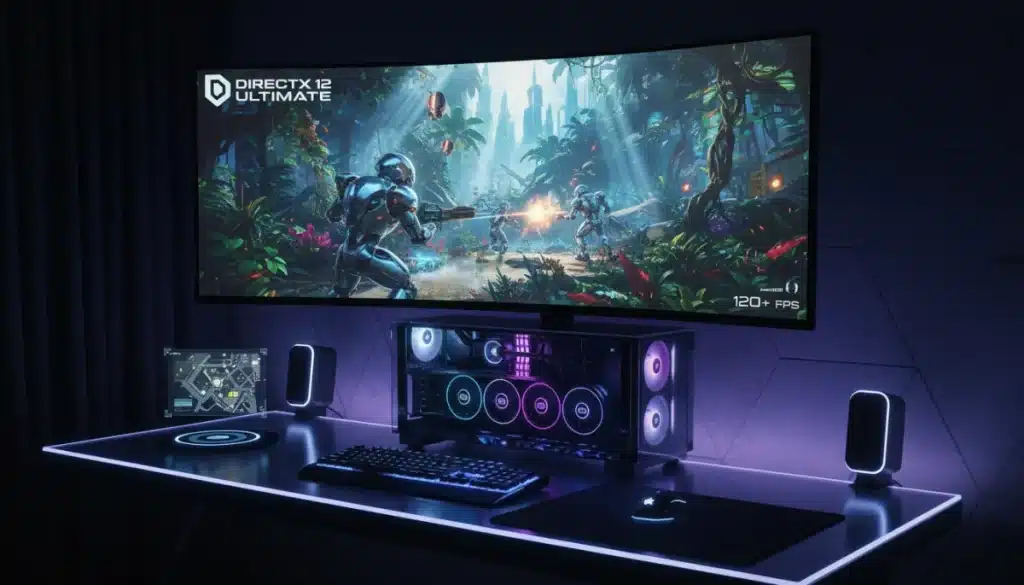
The arrival of DirectX 12 Ultimate has fundamentally redefined the boundaries of virtual realism, setting a new gold standard for high-end rendering.
This comprehensive feature set bridges the gap between hardware and software, ensuring that every pixel on your screen works harder than ever before.
By integrating next-gen innovations like hardware-accelerated ray tracing and mesh shaders, this API empowers creators to build worlds of staggering complexity. For gamers in 2026, it means smoother performance and breathtaking lighting that was once reserved for cinematic post-processing.
This evolution isn’t just a minor patch; it’s a total overhaul of the modern gaming pipeline. As we explore these cutting-edge optimizations, you’ll discover how this unified framework is currently transforming the PC landscape into a more immersive, hyper-realistic playground.
The Foundation of Next-Gen Visuals: Core Features Explained
DirectX 12 Ultimate Graphics bundles several cutting-edge technologies into a cohesive platform, ensuring developers have a unified target for high-end graphics. This consolidation simplifies development while maximizing the capabilities of modern GPUs.
The key features, Ray Tracing, Variable Rate Shading (VRS), Mesh Shaders, and Sampler Feedback, work in concert to push the boundaries of real-time rendering. These innovations are not just incremental improvements but foundational shifts in how graphics are processed and displayed.
By understanding each of these components, we can better appreciate the holistic approach Microsoft has taken with DirectX 12 Ultimate Graphics. This unified platform aims to provide a consistent and powerful experience across all compatible hardware, driving adoption and innovation.
Ray Tracing: Unprecedented Realism
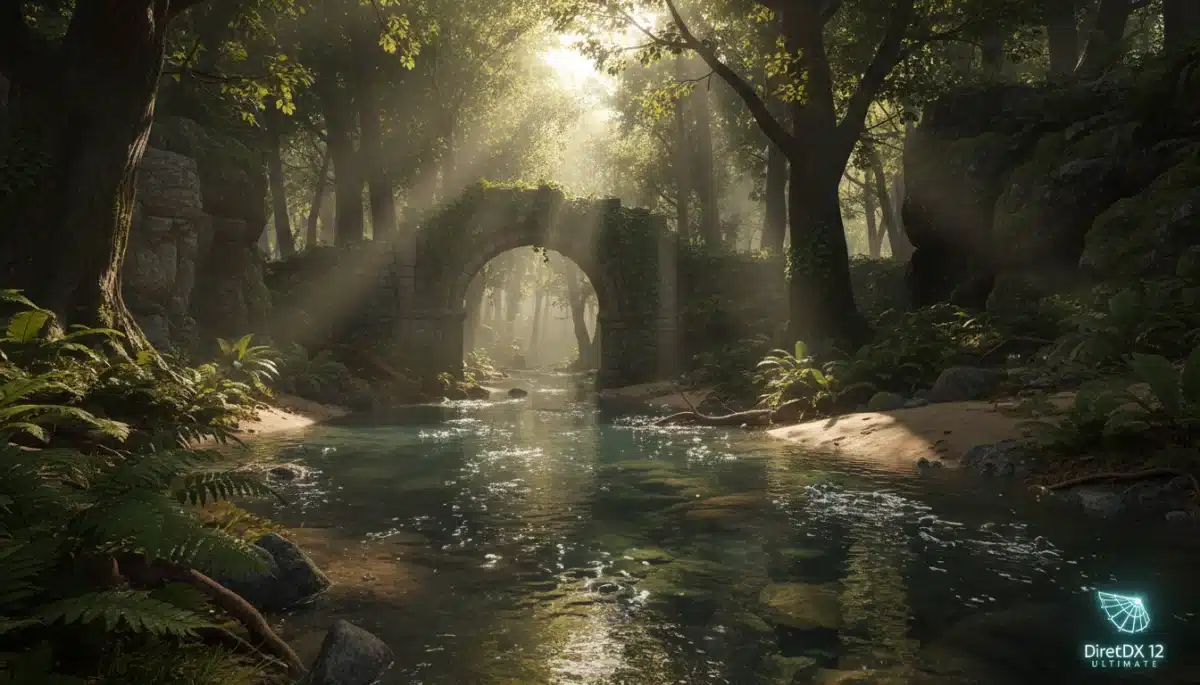
Ray Tracing is perhaps the most talked-about feature of DirectX 12 Ultimate Graphics, enabling hyper-realistic lighting, shadows, and reflections in real time. Unlike traditional rasterization, which approximates light, ray tracing simulates the path of light rays.
This results in visually stunning scenes where light interacts with objects in a physically accurate manner, enhancing immersion dramatically. Games leveraging this technology in 2026 will offer environments that feel truly alive and responsive to dynamic lighting conditions.
The computational demands of ray tracing are significant, but advancements in GPU architecture and software optimization, inherent in DirectX 12 Ultimate Graphics, are making it increasingly viable for mainstream gaming experiences.
- Realistic Lighting: Accurate global illumination and ambient occlusion.
- Dynamic Shadows: Soft, realistic shadows that react to light sources.
- Precise Reflections: Mirror-like reflections on surfaces, enhancing environmental detail.
Variable Rate Shading (VRS): Optimizing Performance
Variable Rate Shading (VRS) is a powerful optimization technique within DirectX 12 Ultimate Graphics that allows developers to selectively reduce the shading rate in areas of the frame where it will have minimal visual impact. This frees up GPU resources for more critical areas.
For example, areas in motion blur, distant objects, or the periphery of the player’s vision can be rendered with fewer shading calculations without a noticeable loss in perceived quality.
This intelligent resource allocation translates directly into higher frame rates and improved overall performance.
VRS is crucial for maintaining smooth gameplay even as graphical fidelity increases, making it a cornerstone of efficient rendering in the DirectX 12 Ultimate Graphics ecosystem. Its adoption will be widespread in games by 2026, ensuring a balance between visuals and frame rates.
Mesh Shaders: Geometric Complexity and Efficiency
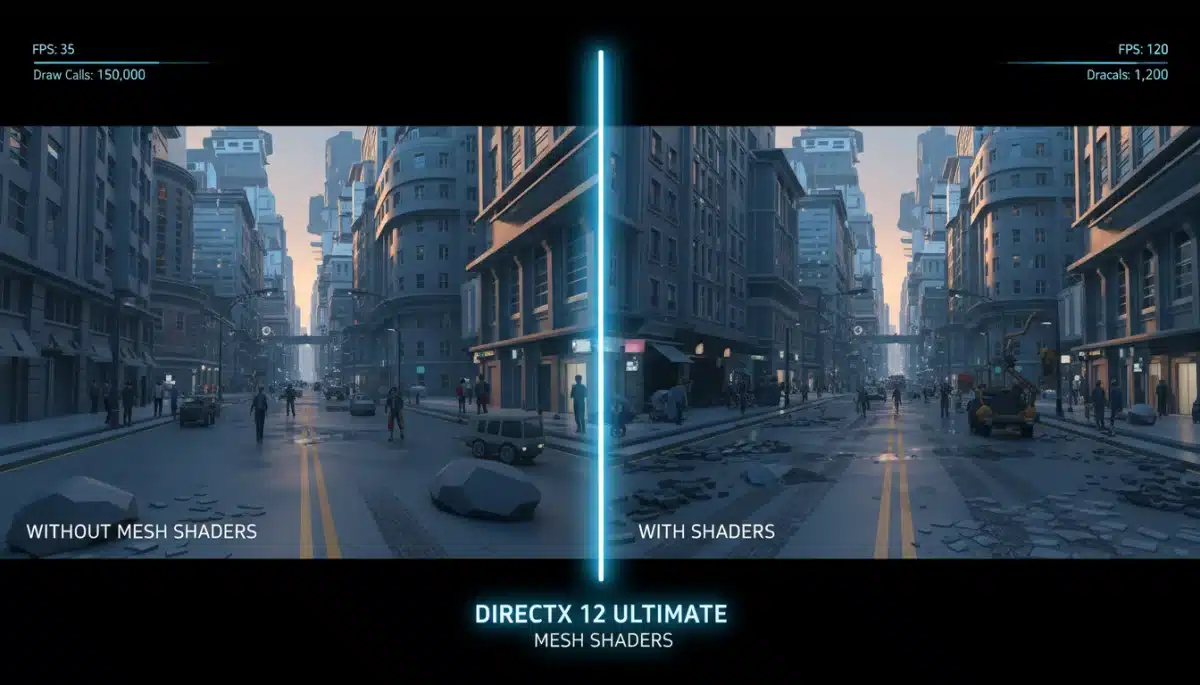
Mesh Shaders represent a fundamental change in how geometric data is processed on the GPU, offering developers unprecedented control over geometry pipelines. This new programmable stage allows for more flexible and efficient rendering of complex scenes.
Traditional rendering pipelines often bottleneck when dealing with highly detailed environments or large numbers of objects. Mesh Shaders, a key feature of DirectX 12 Ultimate Graphics, address this by enabling GPUs to process geometry more intelligently and in parallel.
The result is the ability to render incredibly detailed worlds with far greater efficiency, reducing CPU overhead and allowing for richer, more intricate game environments. This technology will be vital for games pushing visual boundaries in 2026, driven by DirectX 12 Ultimate Graphics.
Sampler Feedback: Enhanced Texture Streaming
Sampler Feedback is another crucial component of DirectX 12 Ultimate Graphics that significantly improves texture streaming and visual quality. It allows the GPU to provide feedback to the game engine about which parts of a texture are actually needed and at what level of detail.
This intelligent feedback loop ensures that only the necessary texture data is loaded into memory, optimizing VRAM usage and reducing loading times. Games can therefore utilize higher resolution textures more effectively without compromising performance.
The efficiency gained from Sampler Feedback means more detailed environments and characters can be rendered smoothly, enhancing the overall visual experience. This feature is integral to maximizing graphical fidelity in the DirectX 12 Ultimate Graphics era.
The combined power of these features within DirectX 12 Ultimate Graphics creates a robust framework for next-generation game development. Developers can leverage these tools to craft experiences that were previously impossible, pushing the boundaries of what PC gaming can achieve by 2026.
The synergy between Ray Tracing, VRS, Mesh Shaders, and Sampler Feedback ensures that every aspect of the rendering pipeline is optimized for both visual quality and performance. This comprehensive approach is what sets DirectX 12 Ultimate Graphics apart from previous API iterations.
As hardware continues to evolve, the capabilities unlocked by DirectX 12 Ultimate Graphics will become even more pronounced, leading to a new era of immersive and graphically stunning PC games. The industry is actively embracing these advancements, anticipating a transformative period.
The Impact on Game Development and Performance
The introduction of DirectX 12 Ultimate Graphics significantly alters the landscape for game developers. It provides a unified, powerful API that streamlines the process of bringing cutting-edge graphics to PC platforms.
This standardization simplifies optimization efforts across different hardware configurations.
Developers no longer need to implement bespoke solutions for various vendors to achieve top-tier visual effects.
Instead, they can focus on leveraging the standardized features of DirectX 12 Ultimate Graphics, knowing their optimizations will translate directly to a broad range of compatible GPUs.
This unified approach fosters greater innovation, as development teams can dedicate more resources to creative endeavors rather than compatibility fixes.
The benefits of DirectX 12 Ultimate Graphics extend from small indie studios to large AAA developers, democratizing access to advanced rendering techniques.
Streamlined Development Workflows
With DirectX 12 Ultimate Graphics, developers gain a clearer, more consistent target for their rendering pipelines. This clarity reduces the complexity often associated with multi-platform or multi-vendor development, leading to more efficient coding and debugging processes.
The standardized feature set means that once a game is optimized for DirectX 12 Ultimate Graphics, it will perform optimally on any compatible hardware. This simplifies quality assurance and reduces the need for extensive platform-specific tweaks, accelerating release cycles.
Ultimately, this streamlined workflow enables developers to allocate more time to content creation and gameplay innovation, leading to richer and more polished gaming experiences. The efficiency brought by DirectX 12 Ultimate Graphics is a game-changer for the industry.
- Unified API: Consistent feature set across compatible hardware.
- Reduced Overhead: Less time spent on hardware-specific optimizations.
- Faster Iteration: Quicker development cycles for graphics features.
Hardware Requirements and Accessibility in 2026
To fully benefit from DirectX 12 Ultimate Graphics, users will need compatible hardware, specifically GPUs that support all its features. NVIDIA’s RTX series and AMD’s Radeon RX 6000 series and newer are designed with these capabilities in mind, ensuring a broad adoption base.
As we move towards 2026, the penetration of DirectX 12 Ultimate Graphics-compatible GPUs in the market is expected to be substantial.
This increased accessibility will mean more gamers can experience the full graphical fidelity offered by the latest titles without needing the absolute highest-end systems.
The continuous innovation in GPU manufacturing, coupled with the standardized API, will drive down costs and make these advanced graphics technologies more accessible to a wider audience. This widespread adoption is crucial for the success of DirectX 12 Ultimate Graphics.
The Future of Gaming with DirectX 12 Ultimate
By 2026, games will be designed from the ground up to leverage the full suite of DirectX 12 Ultimate Graphics features. This means a new standard for visual quality, where realistic lighting, complex geometry, and efficient rendering are commonplace.
The immersive qualities of games will reach new heights, blurring the lines between virtual and reality.
Players can expect more believable worlds, intricate character models, and environments that react dynamically to their actions and the game’s physics, all powered by DirectX 12 Ultimate Graphics.
Beyond aesthetics, the performance optimizations offered by DirectX 12 Ultimate Graphics will enable higher frame rates and smoother gameplay, even in the most demanding scenarios. This combination of visual fidelity and performance will define the PC gaming experience for years to come.
- Enhanced Immersion: More realistic and dynamic game worlds.
- Higher Performance: Smoother gameplay with increased frame rates.
- Developer Innovation: New possibilities for game design and visual storytelling.
Challenges and Considerations for Adoption
While the benefits of DirectX 12 Ultimate Graphics are clear, its full adoption and utilization come with certain challenges. Developers must invest time and resources into understanding and implementing these new features, which can be a steep learning curve for some studios.
Furthermore, the hardware requirements, though becoming more common, still mean that a segment of the PC gaming population might not immediately experience the full advantages. This creates a potential divide between those with cutting-edge systems and those with older hardware.
However, the industry is actively working to bridge this gap through scalable implementations and continuous driver updates.
The long-term vision for DirectX 12 Ultimate Graphics involves making these advanced features accessible to as many gamers as possible, ensuring a broad and inclusive future for PC gaming.
| Key Feature | Brief Description |
|---|---|
| Ray Tracing | Enables realistic lighting, shadows, and reflections for enhanced visual fidelity. |
| Variable Rate Shading (VRS) | Optimizes performance by reducing shading detail in less critical areas of the frame. |
| Mesh Shaders | Provides flexible and efficient processing of complex geometric data for richer worlds. |
| Sampler Feedback | Improves texture streaming and memory usage for higher resolution textures and better efficiency. |
Frequently Asked Questions About DirectX 12 Ultimate Graphics
DirectX 12 Ultimate Graphics is a unified graphics API from Microsoft that bundles several advanced rendering technologies. It aims to provide a consistent and powerful platform for next-generation PC gaming graphics, enabling features like real-time ray tracing and advanced geometry processing.
It enhances graphics through features like Ray Tracing for realistic lighting, Variable Rate Shading for performance optimization, Mesh Shaders for complex geometry, and Sampler Feedback for efficient texture streaming. These combine to create more immersive and visually stunning game worlds by 2026.
To fully utilize DirectX 12 Ultimate Graphics, users need GPUs that support its complete feature set. This includes NVIDIA’s RTX series (20-series, 30-series, 40-series) and AMD’s Radeon RX 6000 series and newer graphics cards, ensuring compatibility and optimal performance.
By 2026, the full impact of DirectX 12 Ultimate Graphics is anticipated to be widely visible. Game developers are increasingly adopting these technologies, and compatible hardware is becoming more prevalent, leading to a new generation of visually advanced titles designed around its capabilities.
Challenges include the learning curve for developers to implement new features and the requirement for compatible, modern hardware. However, ongoing optimization efforts and increasing hardware accessibility are working to mitigate these challenges, fostering broader adoption.
Looking Ahead: The Future of PC Gaming Graphics
The progression of DirectX 12 Ultimate Graphics marks a pivotal moment for PC gaming, setting a new benchmark for visual fidelity and performance.
As we approach 2026, its comprehensive suite of features will undoubtedly redefine player expectations and developer capabilities. The ongoing evolution of hardware and software will continue to unlock even greater potential, fostering an environment where innovation thrives.
This technological leap promises not just prettier games, but more engaging and dynamic experiences, where the virtual world feels increasingly tangible.
The unified nature of DirectX 12 Ultimate Graphics ensures that these advancements are accessible and efficiently utilized across a broad spectrum of gaming systems, driving forward the entire industry.
Monitoring the upcoming game releases and hardware developments will be key to understanding the full scope of its influence.
The continuous push for realism and efficiency, spearheaded by DirectX 12 Ultimate Graphics, ensures that the future of PC gaming remains vibrant and endlessly exciting for enthusiasts worldwide.
