PC Gaming Hardware Trends 2026: Next-Gen GPUs for US Players
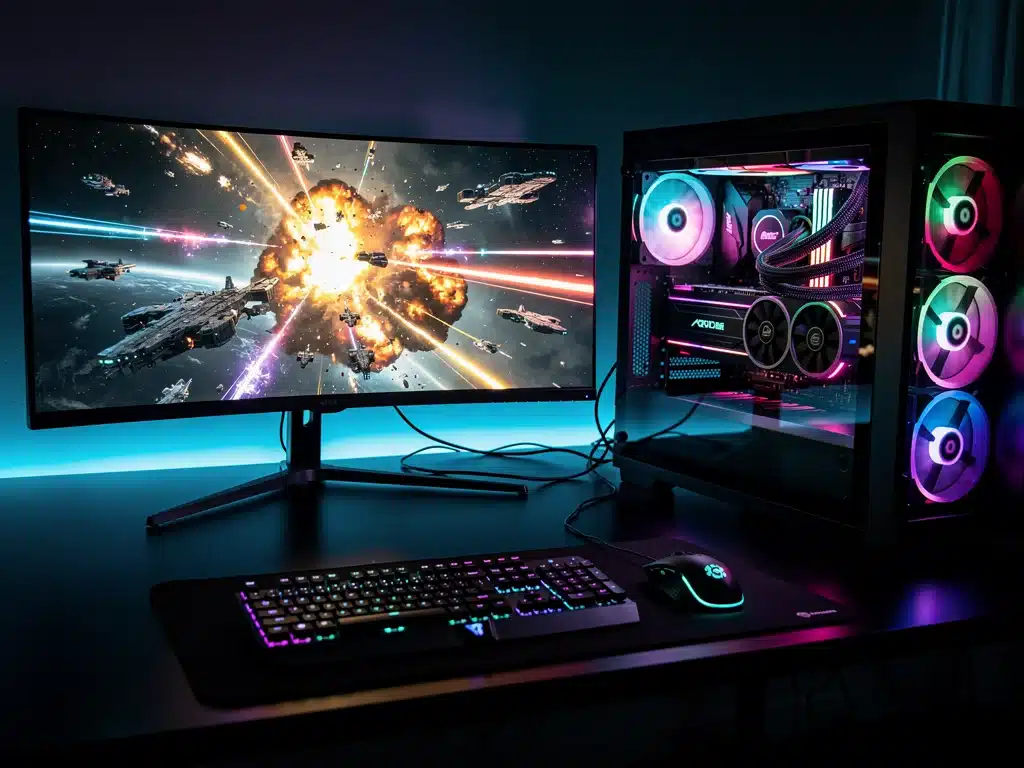
The next generation of desktop graphics is pushing processing boundaries to completely redefine high-end PC performance. By closely monitoring emerging PC Gaming Hardware Trends, American gamers can effectively future-proof their rigs with state-of-the-art visual processing units designed for high-refresh-rate 4K gameplay.
Advancements in ultra-fast GDDR7 memory, neural rendering, and AI-assisted frame generation are driving massive performance leaps across all price tiers.
Hardware manufacturers are aggressively optimizing power efficiency while refining dedicated ray tracing hardware to deliver unprecedented cinematic immersion.
Whether you are aiming for rock-solid framerates or planning a full system overhaul, keeping track of these silicon innovations is essential. Here is what you need to know to navigate the evolving market and build the ultimate gaming machine.
The Dawn of Next-Gen GPU Architectures
As 2026 looms, the industry is buzzing with speculation and confirmed developments regarding the next wave of GPU architectures.
NVIDIA, AMD, and potentially Intel are all working on foundational designs that will push the boundaries of what’s possible in real-time rendering and computational graphics.
These new architectures are expected to bring significant performance uplifts, not just through raw power but also via more efficient processing techniques. We are looking at a future where GPUs are not merely faster but smarter, capable of handling increasingly complex workloads with greater finesse.
The implications for US players are profound, promising more immersive worlds, higher frame rates at extreme resolutions, and new visual paradigms that were previously unattainable. This shift underscores the importance of monitoring these PC Gaming Hardware Trends.
NVIDIA’s Hopper and Beyond: The AI-Driven Future
NVIDIA’s current Hopper architecture has already set new benchmarks, particularly in AI and professional computing, and its successors are expected to further integrate AI into consumer GPUs.
This means more advanced DLSS iterations, potentially even more sophisticated frame generation techniques, and AI-accelerated physics.
The integration of AI cores directly into the GPU silicon is poised to become a standard, moving beyond simple upscaling to potentially dynamic scene generation and intelligent texture streaming.
This could revolutionize how games are rendered and experienced, offering a level of detail and responsiveness previously unimaginable.
For gamers, this translates to not just better graphics but potentially more intelligent game worlds and characters. The processing power will be leveraged to enhance every aspect of the visual and interactive experience, making it a critical component of PC Gaming Hardware Trends for 2026.
- Advanced AI integration for superior visual fidelity.
- Evolution of DLSS with new capabilities.
- Potential for AI-driven game mechanics.
AMD’s RDNA Evolution: Performance and Efficiency
AMD’s RDNA architecture has consistently challenged NVIDIA, and RDNA 4 or 5, expected by 2026, aims to continue this trend with a strong focus on performance-per-watt and competitive pricing.
AMD’s strategy often involves providing excellent value, making their next-gen GPUs highly anticipated by a broad segment of the US gaming market.
Expect significant improvements in ray tracing performance, an area where AMD has been catching up, along with further refinements to their FSR (FidelityFX Super Resolution) technology.
The goal is to offer a compelling alternative that doesn’t compromise on visual quality or frame rates, even for the most demanding titles.
These advancements will ensure that AMD remains a strong contender, offering choices that cater to different budgets and performance expectations. The competition between these giants is a driving force behind the rapid evolution of PC Gaming Hardware Trends.
- Enhanced ray tracing capabilities.
- Further development of FSR technology.
- Strong focus on performance-per-watt.
Memory and Bandwidth: The New Bottleneck Breakers
Beyond the core GPU architecture, memory technology and bandwidth are critical factors in overall performance. High-resolution textures, complex geometric data, and advanced rendering techniques demand massive amounts of fast memory, and 2026 will see significant strides in this area.
We anticipate wider adoption of next-generation memory standards like GDDR7, offering significantly higher bandwidth than current GDDR6X.
This will allow GPUs to feed data to their processing units much faster, reducing bottlenecks and enabling even more intricate graphical detail.
The move towards larger memory capacities on consumer cards will also be a key trend, recognizing the increasing demands of modern games. These developments are integral to the broader PC Gaming Hardware Trends for 2026.
GDDR7 and Beyond: Speeding Up Data Transfer
GDDR7 memory is poised to become a standard feature in high-end GPUs by 2026, offering transfer rates that dwarf previous generations. This leap in bandwidth directly translates to smoother gameplay, faster texture loading, and the ability to handle more complex scenes without stuttering.
This memory upgrade is not merely about capacity but about the sheer speed at which data can be accessed and processed by the GPU.
It’s a fundamental component in enabling the higher resolutions and fidelity that next-gen games will demand, especially in titles leveraging advanced rendering techniques.
For US players, this means less waiting and more playing, with a noticeable improvement in the fluidity of even the most graphically intensive games. It’s a critical piece of the puzzle in understanding the PC Gaming Hardware Trends for 2026.
- Significantly higher memory bandwidth.
- Improved texture loading and scene complexity.
- Reduced bottlenecks for smoother gameplay.
Integrated Memory and Chiplet Designs
Another area of innovation is the potential for more integrated memory solutions, possibly through advanced chiplet designs where memory modules are placed much closer to the GPU die. This could dramatically reduce latency and further increase effective bandwidth, going beyond what discrete memory chips can offer.
While chiplet designs for GPUs are still maturing, 2026 could see initial implementations or at least significant advancements towards this goal. This approach allows for greater flexibility in manufacturing and potentially more cost-effective high-performance solutions.
These architectural shifts are not just about raw specifications; they represent a holistic approach to overcoming traditional hardware limitations. They are a significant part of the PC Gaming Hardware Trends for 2026: What US Players Need to Know About Next-Gen GPUs (Recent Updates).
Ray Tracing and Path Tracing: The Quest for Photorealism
Ray tracing has been a game-changer for lighting, shadows, and reflections, and by 2026, we expect to see its full maturation, with path tracing becoming more commonplace. Path tracing takes ray tracing to the next level, simulating light paths more comprehensively for truly photorealistic rendering.
Current GPUs can handle some level of ray tracing, but 2026 GPUs are designed to make it a default, rather than an optional, graphical setting.
This means games will be built from the ground up with these advanced lighting techniques in mind, delivering stunning visual fidelity without major performance compromises.
For US players, this translates to game worlds that look indistinguishable from reality, with dynamic lighting that reacts naturally to every object and surface. It’s a key driver of the PC Gaming Hardware Trends for 2026.
Ubiquitous Ray Tracing and Path Tracing Integration
The next generation of GPUs will feature significantly enhanced ray tracing cores, capable of processing light rays with unparalleled speed and efficiency.
This will allow developers to implement full global illumination and complex reflections without the massive performance penalties seen in earlier implementations.
Path tracing, currently limited to a few experimental titles, is expected to become a more viable option for mainstream games, offering a level of visual realism that was once confined to pre-rendered cinematics. The computational demands are immense, but 2026 hardware aims to meet them head-on.
This focus on realistic lighting is a testament to the industry’s drive for immersive experiences, making it a central pillar of the PC Gaming Hardware Trends for 2026.
- Dedicated hardware for accelerated ray and path tracing.
- Real-time global illumination in more titles.
- Photorealistic lighting becoming standard.
Synergy with AI Upscaling for Optimal Performance
The performance overhead of advanced lighting techniques like path tracing will be mitigated by increasingly sophisticated AI upscaling technologies. DLSS, FSR, and potentially Intel’s XeSS will continue to evolve, providing near-native image quality at significantly lower rendering costs.
This synergy between advanced rendering and AI-powered upscaling is crucial for achieving high frame rates at 4K and even 8K resolutions with all graphical bells and whistles enabled. It allows GPUs to render fewer pixels internally while delivering a high-quality output to the display.
This combination ensures that US players can enjoy the best of both worlds: stunning visual realism and smooth, responsive gameplay. It’s an essential aspect of the PC Gaming Hardware Trends for 2026.
Power Efficiency and Cooling Innovations
As GPUs become more powerful, their power consumption and heat output also increase, presenting significant challenges for cooling and overall system design. The PC Gaming Hardware Trends for 2026 will emphasize greater power efficiency and innovative cooling solutions.
Manufacturers are investing heavily in optimizing their architectures for better performance-per-watt, meaning more processing power for the same or even less energy. This is not only good for electricity bills but also for managing thermal loads within gaming PCs.
Expect to see continued advancements in vapor chamber cooling, larger heatsinks, and potentially more exotic cooling methods becoming mainstream. These innovations are vital for maintaining stable performance and ensuring the longevity of high-end components.
Optimized Power Delivery and Architecture
Next-gen GPUs will feature more refined power delivery systems and microarchitectural optimizations designed to extract maximum performance from every watt. This means less wasted energy and more efficient computation, leading to cooler operation and potentially quieter systems.
The focus on efficiency is a direct response to the increasing power demands of modern GPUs, aiming to keep them within reasonable thermal and electrical limits.
This ensures that even the most powerful cards can be integrated into a wider range of PC builds without requiring extreme power supplies or cooling setups.
These engineering efforts benefit US players by offering powerful hardware that is also more sustainable and manageable. It’s a key element of the PC Gaming Hardware Trends for 2026.
- Improved performance-per-watt ratios.
- More efficient power delivery systems.
- Reduced heat output and noise.
Advanced Cooling Solutions for Peak Performance
Cooling technology will evolve to meet the demands of these more powerful and efficient GPUs. Expect larger, more intricate heatsink designs, enhanced fan technologies, and more widespread adoption of advanced vapor chambers or even integrated liquid cooling solutions on flagship models.
These cooling innovations are crucial for allowing GPUs to maintain their boost clocks for longer periods, ensuring consistent peak performance during extended gaming sessions. Effective heat dissipation directly impacts a card’s longevity and stability under heavy load.
For gamers, this means reliable performance without thermal throttling, even in demanding environments. This continuous innovation in cooling is an important part of the PC Gaming Hardware Trends for 2026.
The Role of Connectivity: PCIe 5.0 and Beyond
High-speed connectivity is just as vital as the GPU itself, ensuring that data can flow rapidly between the CPU, GPU, and storage. By 2026, PCIe 5.0 will be standard across new motherboards and GPUs, with PCIe 6.0 potentially on the horizon for enthusiast platforms.
PCIe 5.0 doubles the bandwidth of PCIe 4.0, providing ample headroom for even the most demanding next-gen GPUs and NVMe SSDs.
This increased bandwidth is essential for technologies like DirectStorage, which allows games to load assets directly from the SSD to the GPU, bypassing the CPU for faster loading times and more dynamic game worlds.
For US players, this means not only faster loading screens but also the potential for games to stream assets more effectively, leading to more detailed environments and less pop-in. This connectivity push is fundamental to the PC Gaming Hardware Trends for 2026.
PCIe 5.0 as the New Standard
The widespread adoption of PCIe 5.0 will unlock the full potential of next-gen GPUs and high-speed storage. This higher bandwidth interface ensures that data transfer is no longer a bottleneck, allowing these powerful components to operate at their maximum capabilities.
Motherboard manufacturers are already integrating PCIe 5.0 slots, and by 2026, it will be a prerequisite for any enthusiast-grade gaming PC. This standard will facilitate the seamless integration of future hardware, ensuring compatibility and optimal performance for years to come.
This foundational shift in connectivity is a critical enabler for all other GPU advancements. It forms a core part of the PC Gaming Hardware Trends for 2026.
- Doubled bandwidth compared to PCIe 4.0.
- Enables faster data transfer for GPUs and SSDs.
- Crucial for technologies like DirectStorage.
DirectStorage and Game Asset Streaming
DirectStorage, a technology that leverages high-bandwidth NVMe SSDs and PCIe 4.0/5.0, will become an integral part of game development.
By allowing games to load assets directly to the GPU, it drastically reduces loading times and enables developers to create larger, more detailed game worlds without performance hitches.
The benefits extend beyond mere loading screens, impacting how games handle dynamic environments, level streaming, and even character animations. This technology fundamentally changes how game assets are managed, making for a more fluid and continuous gaming experience.
US players can look forward to a future where waiting for games to load becomes a relic of the past, and game worlds feel more seamless and alive. This is a significant factor in the PC Gaming Hardware Trends for 2026.
Cloud Gaming Integration and Hybrid Models
While local hardware remains supreme for many enthusiasts, cloud gaming is an undeniable trend that will influence hardware development, even for local machines.
By 2026, we might see more hybrid models where some computationally intensive tasks are offloaded to the cloud, even for local PC games.
This doesn’t necessarily mean the end of local GPUs but rather a complementary relationship, where cloud resources augment local processing power for specific features or ultra-high fidelity rendering. This could expand access to cutting-edge graphics for players with less powerful local hardware.
The implications for PC Gaming Hardware Trends for 2026 are complex, potentially leading to new software paradigms and even new GPU features designed to interact seamlessly with cloud services.
Complementary Cloud Processing
Imagine a scenario where a local GPU handles the core rendering, but highly complex physics simulations or advanced AI behaviors are computed in the cloud and streamed back to your PC.
This hybrid approach could unlock new levels of game complexity and realism without requiring every player to own the most expensive hardware.
This model could also facilitate dynamic scalability, allowing games to adjust their graphical fidelity based on available cloud resources and local internet speeds. It’s an intriguing prospect that could reshape how we think about gaming hardware.
For US players, this could mean a more accessible path to experiencing bleeding-edge graphics, even if their local setup isn’t top-tier. It’s a fascinating aspect of the PC Gaming Hardware Trends for 2026.
- Offloading intensive tasks to cloud servers.
- Expanding access to high-fidelity graphics.
- Potential for dynamic scalability in games.
Impact on GPU Design and Features
The rise of hybrid cloud gaming could influence GPU design, leading to hardware optimized for efficient data transfer with cloud services or specialized cores for handling streamed computations. This might encourage more standardized APIs for cloud integration, ensuring smooth interoperability.
While local processing power will always be paramount for competitive gaming and maximum fidelity, the cloud offers a compelling way to augment and extend capabilities. This dual approach will shape the development trajectory for next-gen GPUs.
Understanding this evolving relationship is key for anyone following the PC Gaming Hardware Trends for 2026.
AR/VR Integration and GPU Demands
Augmented Reality (AR) and Virtual Reality (VR) are steadily gaining traction, and by 2026, their hardware demands will significantly influence GPU development.
High-resolution VR headsets require immense graphical horsepower to render two separate, high-fidelity images at high frame rates with minimal latency.
Next-gen GPUs will be designed with specific optimizations for AR/VR workloads, including foveated rendering (where only the area the user is looking at is rendered in full detail) and advanced distortion correction. This ensures a comfortable and immersive experience without motion sickness.
For US players interested in the metaverse and immersive virtual worlds, these GPU advancements are crucial. They form a specialized but growing segment of the PC Gaming Hardware Trends for 2026.
Specialized VR/AR Rendering Pipelines
Future GPUs will likely feature dedicated hardware or highly optimized software pipelines for VR and AR rendering. This specialization will allow for more efficient processing of the unique demands of these technologies, such as high refresh rates for each eye and extremely low latency.
The goal is to push VR experiences beyond their current limitations, making them more realistic, comfortable, and accessible. This includes improving the visual clarity to reduce the “screen door effect” and enhancing tracking accuracy for seamless interaction.
These dedicated optimizations are vital for the continued growth of immersive gaming. They represent a significant aspect of the PC Gaming Hardware Trends for 2026: What US Players Need to Know About Next-Gen GPUs (Recent Updates).
- Dedicated hardware for VR/AR workloads.
- Improved foveated rendering techniques.
- Lower latency for enhanced immersion.
Higher Resolutions and Wider Fields of View
The next generation of VR headsets will push for even higher resolutions and wider fields of view, demanding exponentially more from GPUs.
Rendering photorealistic environments across a broad visual spectrum at high frame rates is an immense challenge that only next-gen GPUs can meet.
This push for visual fidelity in VR will also drive innovations in display technology and lens design, creating a symbiotic relationship between graphics cards and head-mounted displays. The entire ecosystem must evolve in tandem to deliver truly groundbreaking experiences.
US players can anticipate a future where virtual worlds are virtually indistinguishable from reality, thanks to these combined hardware advancements. This is a crucial element of the PC Gaming Hardware Trends for 2026.
Sustainability and Manufacturing Innovations
Beyond raw performance, the PC Gaming Hardware Trends for 2026 will also focus on sustainability and manufacturing innovations. As environmental concerns grow, hardware manufacturers are under increasing pressure to produce more eco-friendly components.
This includes adopting more sustainable materials, improving manufacturing processes to reduce waste and energy consumption, and designing GPUs that are more energy-efficient throughout their lifecycle.
Consumers are also becoming more conscious of the environmental footprint of their technology.
While performance remains paramount, the environmental impact of manufacturing and operating powerful gaming hardware is becoming an increasingly important consideration for both producers and consumers.
Eco-Friendly Manufacturing and Materials
Expect to see a greater emphasis on using recycled materials in GPU components and packaging, as well as manufacturing processes that reduce carbon emissions and hazardous waste. Companies are likely to highlight their efforts in this area as a selling point.
This shift towards sustainability isn’t just about public perception; it’s also driven by regulatory pressures and the long-term viability of resource-intensive manufacturing. Innovations in this space will shape the entire hardware supply chain.
For US players, this means supporting companies that are committed to reducing their environmental footprint, aligning their gaming passion with broader ecological responsibility. It’s a growing part of the PC Gaming Hardware Trends for 2026.
- Increased use of recycled materials.
- Reduced carbon footprint in manufacturing.
- More energy-efficient production processes.
Longevity and Upgradeability
While rapid innovation often implies frequent upgrades, there’s also a growing movement towards designing hardware with greater longevity and potential for upgradeability.
This could manifest in more robust component lifespans or modular designs that allow for easier component replacement.
The goal is to reduce electronic waste and provide consumers with more flexible options for extending the life of their gaming rigs. While full modularity in GPUs is challenging, smaller steps towards repairability and extended support are likely.
This trend benefits US players by offering more sustainable and cost-effective long-term gaming solutions. It’s an often-overlooked but crucial aspect of the PC Gaming Hardware Trends for 2026.
| Key Trend | Expected Impact |
|---|---|
| Next-Gen GPU Architectures | Significant performance leaps, AI integration for visuals. |
| Advanced Memory & Bandwidth | GDDR7 adoption, reduced bottlenecks, faster asset loading. |
| Photorealism via Path Tracing | Widespread photorealistic lighting, enhanced immersion. |
| Power Efficiency & Cooling | Sustainable, stable performance with innovative cooling. |
Frequently Asked Questions About PC Gaming Hardware Trends for 2026
The main advancements for 2026 GPUs include new architectures from NVIDIA and AMD, significant AI integration for rendering, and the widespread adoption of GDDR7 memory. Expect substantial improvements in ray tracing, path tracing, and overall performance-per-watt efficiency.
US players can anticipate more immersive game worlds with photorealistic graphics, higher frame rates at extreme resolutions, and faster loading times due to technologies like DirectStorage. The focus on efficiency also means potentially cooler and quieter systems.
While new hardware will offer superior performance, current high-end PCs will likely remain capable for many games. However, to experience the full potential of next-gen titles with all graphical settings maxed out, an upgrade to a 2026-era GPU will likely be necessary.
AI will be crucial, enhancing upscaling technologies like DLSS and FSR, and potentially enabling AI-accelerated physics and dynamic scene generation. It will help overcome performance challenges posed by advanced rendering techniques, making photorealism more achievable.
PCIe 5.0 is critically important as it doubles bandwidth, eliminating data bottlenecks between the CPU, GPU, and storage. This ensures next-gen GPUs can operate at peak performance and fully utilize features like DirectStorage for faster game asset loading and streaming.
What this means
The evolving PC Gaming Hardware Trends for 2026 indicate a pivotal moment for gaming technology. These advancements promise not just incremental improvements but a transformative leap in visual fidelity, performance, and immersive experiences.
US players should closely monitor announcements from NVIDIA, AMD, and Intel, as their innovations will define the standard for future gaming.
The synergy between AI, advanced rendering, and high-speed connectivity will reshape how games are developed and played, making informed decisions about hardware upgrades more critical than ever.
